Nursery Materials & Sleep
A Parent’s Guide to Naturepedic Nursery Materials and Certifications
Preparing a nursery is an exercise in deciding what deserves attention. A label may promise organic cotton; a product page may list several certifications; a mattress or pad may have a construction that sounds reassuringly precise. The useful questions are quieter and more practical: What is this item made of? What does its certification actually cover? Will it fit, and can it be cared for in the ordinary, sometimes chaotic life of a household?
Published October 28, 2026
For parents comparing Naturepedic nursery options—or any nursery bedding—the word organic can feel like both a promise and a puzzle. It may refer to the cotton in a cover, the materials used in a particular component, or a product that has been certified to a defined standard. Those distinctions matter. A certification is not a general halo cast over every part of a product, and a material description is not necessarily a third-party certification.
The point of looking closely is not to turn a crib into a laboratory. It is to make a considered choice with the information available, without mistaking marketing language for a safety guarantee. This guide explains how to read material descriptions and certification claims, what to check in construction and care instructions, and how to keep bedding decisions grounded in a baby’s actual sleep environment.
Begin with the product, not the adjective
Nursery bedding is a small category with a surprisingly large vocabulary. A fitted sheet, mattress pad, mattress cover, and mattress are not interchangeable things. Each sits at a different point in the bed’s construction, and each has a different job. A sheet covers the sleep surface. A pad may add a thin protective or cushioned layer. A mattress cover may be intended to protect the mattress from moisture or wear. A mattress provides the underlying sleep surface.
That distinction is especially important when comparing products marketed as organic. A company might describe a fabric as organic, identify an organic component, or state that a product is certified under an organic textile standard. These statements do not necessarily mean the same thing. Read the precise wording beside the specific item you are considering, and look for the scope of the claim: does it concern the fabric, the filling, the finished product, or a particular stage of production?
It is also useful to separate material questions from sleep-safety questions. A choice of cotton, wool, or another fill does not by itself establish that a product is suitable for every infant sleep situation. For current safe-sleep guidance, consult your pediatrician and recognized public-health resources. Bedding should not be treated as a substitute for that guidance.
What GOTS certification tells you
GOTS, the Global Organic Textile Standard, is a certification system for textiles made with organic fibers. Its requirements address more than the origin of a fiber; the standard also includes criteria relevant to processing and other stages in the textile supply chain. The details depend on the product and the certification scope, so it is worth checking what a particular claim covers rather than assuming that every material or component has identical status.
When a nursery item is described as GOTS certified, look for a clear reference to the standard and, where available, certification details that can be verified. Ask whether the certificate applies to the finished product or to a named material or process. A retailer’s summary can be helpful, but the documentation behind the claim is more informative than a green leaf, a reassuring color palette, or the word “natural” printed in large type.
Certification is best understood as evidence that defined requirements have been assessed—not as a guarantee that a product is free of every substance a parent might wish to avoid, nor as a complete evaluation of how the product will perform in a particular home. Standards have boundaries. They do not answer every question about fit, durability, washing, comfort, or suitability for a specific crib and mattress.
Parents may also encounter terms such as “organic cotton,” “chemical-free,” or “non-toxic.” These phrases can be used in different ways and may not carry the same independent verification as a named certification. A careful reader looks for the standard, the scope, and the documentation. If a claim is vague, it is reasonable to ask the manufacturer or retailer to clarify it.
Read the materials list as a small map
A product’s materials list can reveal how it is put together. For a mattress pad, for example, the cover and fill may be made from different fibers. “Cotton cover” tells you about the outer surface; it does not establish what is inside. “Organic cotton fill and cover” is more specific, though the certification claim still deserves its own check. If the description lists a blend, note the proportions when they are provided.
Cotton is familiar and often washable, but its feel and performance vary with weave, weight, and finish. Percale, for instance, describes a weave rather than a certification or a guarantee of a particular environmental standard. Wool may be chosen for its insulating and moisture-managing qualities, but care requirements can be more demanding, and the source and treatment of the wool may matter to a household. Latex appears in some sleep products, but it is not the same thing as cotton or wool; material origin, processing, and possible sensitivities are separate questions.
Look for construction language, too. Quilting, elastic edges, pocket depth, seams, and attachment points can affect how a pad sits and how easily it comes off for washing. A description that gives dimensions and construction details is more useful than one that relies chiefly on adjectives such as “plush” or “pure.” The language of comfort can be appealing; the language of construction helps you decide whether the item will work.
For a nursery, the most relevant details may be plain ones: the exact dimensions, whether the item is intended for a standard crib mattress, how it attaches, and whether the finished surface remains smooth and secure. Never assume that a product fits simply because its name includes the word “crib.” Compare its stated dimensions with the mattress and follow the product instructions.
A crib pad is not a mattress
It is easy for the categories to blur when a product is described as protecting a mattress and improving comfort. A pad may help shield a mattress from everyday wear, but it does not change the identity of the underlying mattress or replace its specifications. Nor should a layer be added simply because it sounds softer or more luxurious. Before using any bedding accessory in a crib, review current infant sleep recommendations and the instructions for both the mattress and the accessory.
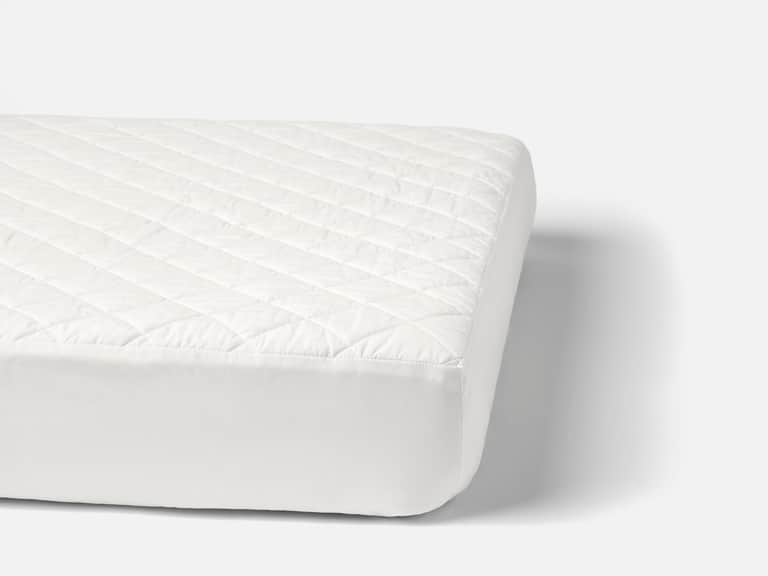
One example of the type of detail worth examining is a crib pad described as made from 100 percent organic cotton inside and out, with two-inch quilted squares, a percale cover, and GOTS certification. Its care instructions specify a cold, gentle machine wash and low tumble drying, and its dimensions are listed as 28 by 52 by 8 inches. These details make it possible to assess fiber content, construction, care, and sizing separately. They do not, on their own, establish that the item is a Naturepedic product or that it is appropriate for every crib setup.
That last distinction is important when researching a particular brand. Naturepedic’s current product information should be consulted for the materials, certification scope, dimensions, and care requirements of the specific model under consideration. A general discussion of organic nursery bedding cannot substitute for the current label or documentation for an individual item. Product lines and specifications can change; a detail found in an older listing may no longer describe the product being sold today.
Certifications are useful; they are not magic words
Certification can bring a welcome degree of accountability to a crowded marketplace. It gives the shopper something more concrete than a brand’s own description and a way to ask what standard was applied. But no single certification answers every question a family might have. A textile standard does not tell you whether a crib mattress is the correct size for your crib, how an item behaves after repeated laundering, or whether its care instructions fit your household.
It helps to read claims in layers. First, identify the material claim: what fibers or substances are listed? Second, identify the certification: which organization or standard is named? Third, identify the scope: which part of the item or production process is covered? Finally, consider ordinary use: will it fit, can it be cleaned as directed, and does the product’s intended use match yours?
Where possible, use the manufacturer’s product page and certification records rather than relying exclusively on a retailer’s shortened summary. If a certificate is not readily available, ask for the certificate number or the name of the certifying body. A thoughtful company should be able to explain what its claim means without converting the answer into a sales pitch.
Be wary of claims that are sweeping but undefined. “Chemical-free,” taken literally, is not a useful description of a textile; all materials are made of chemicals in the scientific sense. More precise claims—such as a named certification, a stated fiber composition, or a disclosure that a product is made without a particular finish—are easier to evaluate. Specificity is not proof by itself, but it gives a parent something real to investigate.
Fit, washing, and the life after unboxing
The nursery is not a showroom. A pad that looks immaculate on a product page must still survive the repeated laundry of infancy, fit the mattress without bunching, and dry in a reasonable amount of time. Care instructions are therefore part of the product’s practical design, not fine print to be read after a spill.
Check the recommended water temperature, cycle, detergent guidance, drying method, and any warnings about bleach or fabric softener. Some items are machine washable; others require spot cleaning or professional care. A natural fiber does not automatically mean easy care, and a washable label does not mean that every wash cycle is appropriate. Follow the manufacturer’s instructions, since heat and agitation can affect dimensions, elastic, quilting, and fabric performance.
Dimensions deserve the same attention. Measure the mattress and compare those measurements with the accessory’s stated size and intended fit. If a pad has deep pockets or elastic edging, confirm that those features correspond to the mattress thickness. A snug, correctly fitted item is a matter of function as well as convenience. If it shifts, wrinkles, or does not sit as intended, discontinue use and consult the product maker or your child’s health-care provider for guidance.
Finally, consider what is included. A listing may describe one pad, one cover, or a set. The words “crib bedding” can refer to a broad category, not a complete bundle. A quick inventory of the actual components can prevent both unnecessary purchases and mistaken assumptions about what belongs in the crib.
A practical checklist for comparing Naturepedic nursery options
When looking at a Naturepedic nursery product, or comparing it with another brand, keep the questions close at hand. They need not be answered in any particular order, though the first few tend to clear away much of the fog.
- What is the item? Identify whether it is a mattress, fitted sheet, pad, protector, or another accessory.
- What is each component made from? Separate the cover, fill, backing, skirt, and any other listed materials.
- What does “organic” mean here? Look for a precise fiber claim and whether it applies to the whole item or only a component.
- Which certification is named? Find the standard, certifying body, and any available verification details.
- What is the certification scope? Confirm whether the claim concerns the finished product, materials, or a part of manufacturing.
- Will it fit the intended mattress? Compare stated measurements and follow the product’s fitting instructions.
- How is it cleaned? Check washing, drying, detergent, and other care directions before buying.
- Is the information current? Use the listing and documentation for the exact model, not an old review or a similar product’s label.
- Does the product suit the intended use? Consult current safe-sleep guidance and ask a pediatrician when you have questions about your child’s sleep environment.
This checklist is deliberately unglamorous. It trades the grand promise of a perfect nursery for the less dramatic satisfaction of knowing what an item is, how it is made, and what it will ask of you in daily use. For many families, that is the more durable kind of reassurance.
Making a decision without chasing perfection
Parents are often asked to make decisions in a marketplace that treats every choice as a referendum on care. A mattress cover becomes a symbol; a certification becomes a test of diligence. Yet a nursery is made of many small decisions, and no single purchase can carry the whole burden of keeping a child healthy or ensuring a night of uninterrupted sleep.
Material transparency and independent certification can be meaningful considerations, particularly for families who want to understand what touches a baby’s bedding. They are most useful when paired with close reading of product specifications, realistic attention to care, and respect for current safety guidance. A label is a starting point for inquiry, not a substitute for it.
In the end, comparing Naturepedic nursery materials is less about memorizing a vocabulary of seals and acronyms than about learning to ask clear questions. Which fibers are present? What does the certification cover? How does the item fit? What happens when it needs washing? Is this accessory designed for the use I have in mind? Answer those, and the choices become less mysterious—not perfect, perhaps, but legible. And in the months when sleep itself is often anything but legible, that is a modest and useful achievement.